
By AEB (Pablo)

We know the congratulatory messages have stopped coming in, or they are few and far between by now. This means, people, your supporters and otherwise, have taken the back seat to watch you work and implement your plans.
Indeed, what matters now is seeing you stand up to implement all you have said, before you won the Sierra Leone Football Association (SLFA) presidency.
True, achieving this position means a lot to you, and to those who voted for you.
We want it also to mean a lot for football-loving fans, and for the people of Sierra Leone who want football to grow and succeed under your stewardship.
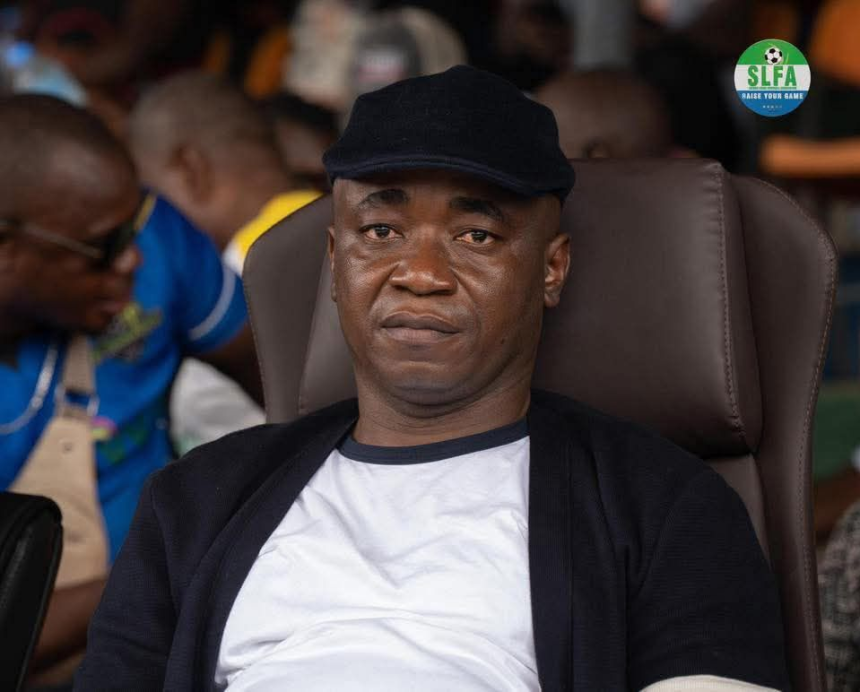
We listened attentively to your recent victory speech as the newly elected President of the Sierra Leone Football Association. We duly noticed also your gratitude, unity call, and bold vision for the game’s future. What a man, someone would say. To us, results matter, and you being a go-getter, that will be a small thing.
Like you said, football is and should be “the real winner.”
Furthermore, we fully agree with you that football stakeholders should set aside past grievances, avoid treating competitors as enemies, and work together across regions, ethnicities, religions, and political lines.
Remember also that we duly noted your commitment to transparency and development, and we will support you to the hilt in your quest to run a transparent, inclusive, and development-driven administration, focusing on youth talent, club growth, and international competitiveness.
Nay, you can’t achieve all of the above without the support of others. Thus, we also appreciate and urge the Government of Sierra Leone, the National Sports Authority, the Ministry of Sports, and international bodies like FIFA, CAF, and WAFU for their continual and unwavering support.
Challenges
Those who know him tell us that Babadi’s leadership style is hands-on, visionary, and unapologetically ambitious. He is not just managing football, but he is reshaping its future.
Although Babadi’s presidency of the SLFA holds promise, it will likely face key challenges.
Restoring Trust and Stability
The very first challenge will be restoring trust and stability.
The SLFA has been rocked by years of controversy, legal battles, and leadership disputes. So, he must rebuild confidence among clubs, players, and fans who’ve grown skeptical of football governance.
Balancing Club and National Interests
Secondly, as the former Executive Chairman of Bo Rangers, Kamara will need to prove impartiality and avoid favoritism.
There is also the aspect of managing tensions between local clubs, and the national team will be critical to maintaining unity.
Fighting Corruption and Mismanagement
Under this caption, Babadi will need the iron fists of Mike Tyson. We all know previous administrations faced allegations of financial irregularities and poor accountability. He shouldn’t allow himself to be caught in the chain-like web of corruption at all.
Although he has pledged transparency, enforcing discipline and cleaning up internal systems will be a major test.
Infrastructure and Grassroots Development
While he has built the Southern Arena, we think that expanding facilities nationwide, especially in underserved regions, will require strategic planning and funding.
A further hurdle will be in the revival of school and district leagues. It is certainly ambitious as it demands coordination and long-term investment.
International Representation and Performance
Here is where the reggae is in its entirety. Our national team, the Leone Stars, has struggled in major tournaments. We look forward with bated breath to see how Babadi and his executive will elevate the team’s competitiveness while navigating CAF and FIFA politics, which can be complex and unforgiving.
Truly, it is a long and arduous three-year tenure for him.
Add to that political and regional pressures.
Who doesn’t know that football in Sierra Leone is deeply intertwined with regional loyalties and political influence?
We will say little about this for now and hope that Babadi’s diverse executive team is a good start, but maintaining neutrality and inclusivity will be a constant balancing act.
Babadi’s next steps
In conclusion, here’s what we think his next steps should take, as tackling corruption in the SLFA will require bold, multi-layered strategies that go beyond surface-level reforms.
Governance Reform & Structural Transparency
The SLFA needs independent oversight committees: He should establish bodies with no ties to SLFA leadership to audit finances and review decisions.
The SLFA needs public disclosure of financials; they should publish budgets, sponsorship deals, and expenditures regularly to build public trust.
Of utmost importance are term limits and rotation policies: everything must be done to prevent power entrenchment by limiting tenure for key positions.
Whistleblower Protection & Reporting Channels
The importance of whistle-blowing cannot be overemphasized at all. The SLFA needs anonymous reporting systems; thus, it should create secure platforms for players, staff, and fans to report misconduct.
Most importantly, there must be legal safeguards that will ensure whistleblowers are protected from retaliation, backed by our national anti-corruption laws.
Digitalization & Financial Controls
Next steps should be having automated payment systems, wherein the SLFA should use digital platforms to track and disburse funds, reducing manual interference.
And, if this is not too far-fetched or wild, let the SLFA employ the use of blockchain for transparency purposes. It it comes with safety if they use blockchain tech for contracts and transfers to prevent tampering.
Education & Integrity Trainings
Mandatory ethics workshops are a necessity: It is essential to train SLFA staff, referees, and club officials on anti-corruption principles, including embedding integrity values in grassroots programs to shape future leaders.
Multi-Stakeholder Collaboration and International Best Practices
Without gainsaying, the SLFA should work with bodies like the Anti-Corruption Commission, and always encourage watchdog journalism and public scrutiny to keep SLFA accountable.
And they should learn from models like the FIFA Global Integrity Program, which builds capacity to fight match-fixing and fraud, and adapt lessons from European associations that have implemented robust governance reforms and independent reviews.
Institutional Resistance
Well, long-standing officials may resist change, especially if reforms threaten their influence or expose past misconduct, while entrenched networks can slow down or sabotage transparency efforts from within.
In instances like that, keep your head up like Tupac would say, and insist on doing the right thing.
Lack of Capacity and Resources
Babadi should think hard and fast regarding lack of capacity and securing resources as implementing digital systems, audits, and training programs requires skilled personnel and funding.
Coming from the provinces should remind him that smaller regional clubs often struggle to comply with new standards due to limited infrastructure, so giving them support is a necessity.
Complex Governance Structures & Cultural and Social Norms
Football associations often operate within overlapping layers of local, national, and international regulations. So, he should align SLFA reforms with CAF and FIFA expectations while maintaining local relevance.
In some contexts, informal practices like favoritism or gift-giving are deeply embedded. Changing mindsets around integrity and accountability takes time and consistent education.
Political Interference
Aha, aha, aha. Football in Sierra Leone is highly politicized. External pressure from government or influential figures could derail independent oversight. Babadi must walk a tightrope between collaboration and autonomy.
Weak Enforcement Mechanisms
Well, even with strong policies, enforcement is often the Achilles’ heel. Don’t relent, Babadi. Without empowered watchdogs and legal backing, violations may go unpunished.
Short-Term Pushback vs Long-Term Gains
You are new in the position, certainly, thus early reforms may cause friction, such as delays in payments, stricter audits, or exposure of past misdeeds. You need the wisdom of Solomon to manage expectations and communicate the long-term benefits clearly to stakeholders.
Let’s be clear, here and now. These next steps and challenges aren’t insurmountable, but they require strategic finesse, coalition-building, and relentless commitment. In conclusion, we will repeat our earlier statement that Babadi Kamara would not achieve all the above alone. He needs the support from all of us. Count us as one such supporter. By Abel E. Bangura (Pablo)